The Texas food truck license is the DSHS Mobile Food Vendor (MFV) License, issued by the Texas Department of State Health Services under HB 2844 since July 1, 2026. It costs $309 (Type I), $1,018 (Type II) or $1,376 (Type III), is valid statewide for one year, and is required for each vehicle. You also need a food manager certification, food handler cards, a sales tax permit, a commissary or CPF exemption, and, in most big cities, a local fire permit.
The Texas Food Truck License at a Glance
| Question | Answer |
|---|---|
| Official name | Mobile Food Vendor (MFV) License |
| Issued by | Texas Department of State Health Services (DSHS), not your city or county |
| Law | HB 2844 (89th Legislature), Texas Health and Safety Code Ch. 437B; rules in 25 TAC Ch. 226. Effective July 1, 2026 |
| Who needs it | Every mobile food vendor: trucks, trailers, pushcarts, roadside vendors, catering vehicles |
| Cost | $309 · $1,018 · $1,376 (Type I · II · III) |
| Where it's valid | Anywhere in Texas |
| How many | One per vehicle |
| How long it lasts | One year from the date you pass the pre-licensing inspection |
| Where to apply | DSHS Regulatory Services Online Licensing (login help · account setup) |
| DSHS contact | MobileFoodVendor@dshs.texas.gov · 512-406-2644 |
Every License and Permit a Texas Food Truck Needs
When people search "food truck license Texas," they usually mean the whole stack: everything that has to be in place before the truck can legally sell. Here it is in one table:
| License / permit | Who issues it | Who needs it | Typical cost |
|---|---|---|---|
| DSHS Mobile Food Vendor License | Texas DSHS | Every vehicle | $309 – $1,376 |
| Food Manager Certification | State-approved provider | Operations handling TCS (time/temperature-controlled) food | ~$100 – $150 |
| Food Handler Card | State-approved provider (some cities run their own) | Every food-handling employee | ~$15 – $25 each |
| Texas Sales and Use Tax Permit | Texas Comptroller | Anyone selling taxable items | Free |
| CPF (commissary) authorization or CPF exemption | Licensed commissary, or your own exemption letter to DSHS | Most Type II and Type III trucks | Set by the facility |
| Fire marshal permit | City fire department | Units with propane or cooking equipment, in most large cities | About $50 – $300, by city |
| Zoning / location approval | City | Depends on the city and where you park | Varies |
DSHS fees: official DSHS Mobile Food Vendor fee schedule (verified July 2026). Certification costs: typical provider pricing. Fire permit range from official city pages read September 29, 2026: Brownsville LP-gas tank permit $50, El Paso annual fire inspection $125, Dallas $195–$205, Austin $222, Houston $225.14, San Antonio $300 + 3%. Full fee breakdown →
License vs. food handler card vs. food manager certification
These three get mixed up constantly, especially when people search for a "Texas food handlers permit":
- Food handler card: a short food-safety course for each employee who handles food. Cheap and quick. It is not a license to operate.
- Food manager certification: a higher-level exam for the person in charge. DSHS inspectors check that it's current and on the vehicle. An expired one is one of the most common inspection failures.
- Mobile Food Vendor License: the license for the vehicle. This is the one that lets the truck sell food.
Want your exact total for your truck: DSHS fees, certifications and your city's fire permit?
FREE COST CALCULATOR →Type I, II or III: Which License Do You Need?
DSHS licenses trucks by what you do with the food, not by the vehicle. Your type sets your fee, your inspection, and whether you need a commissary. Picking the wrong type is one of the most common reasons an application gets sent back.
Type I: Prepackaged
Prepackaged food only, no open food prep. No pre-licensing inspection fee.
Type II: Limited prep
$618 application + $400 inspection. Minimal prep for immediate service: snow cones, hot dog carts, coffee, deli trailers. Annual routine inspection $400.
Type III: Full prep
$876 application + $500 inspection. Cooks and serves made-to-order food: taco trucks, burger rigs, BBQ trailers. Annual routine inspection $500.
Not sure? The free 2-minute type quiz tells you, and the Type I, II & III requirements guide shows what each one requires of your unit. Running a taco truck? See how to license a taco truck under HB 2844.
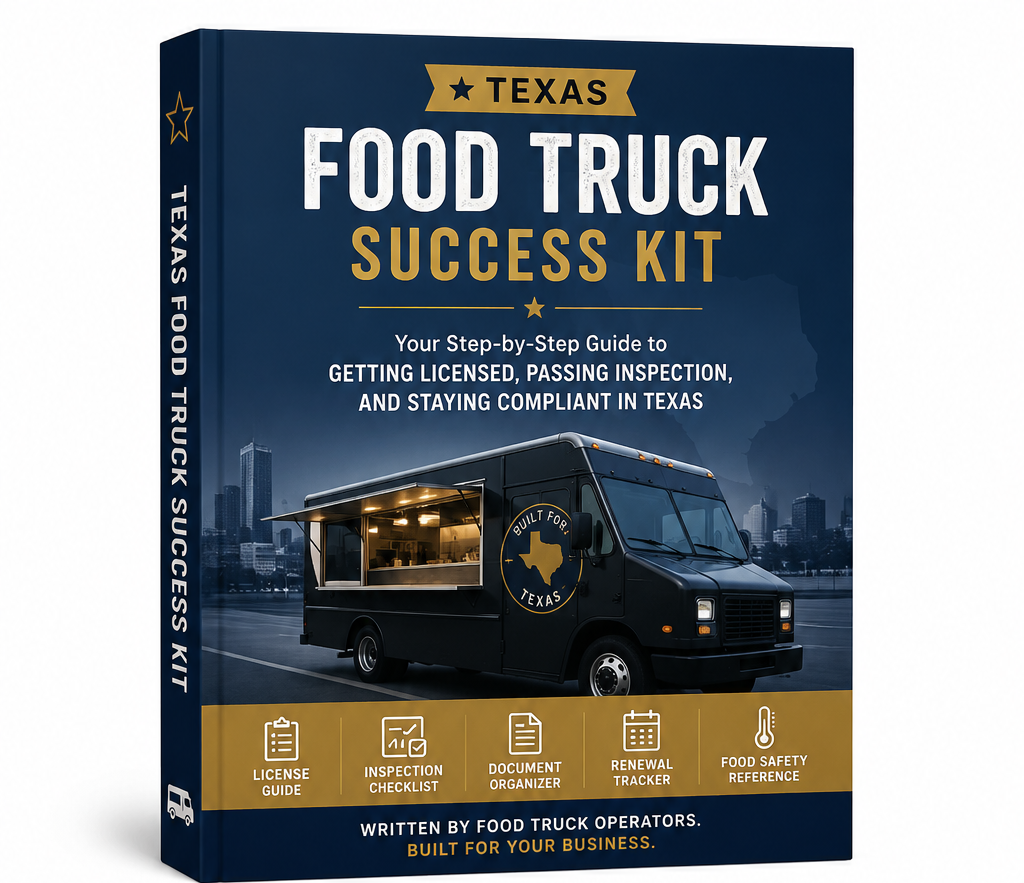
Get the Whole License Process in One Place
The Texas Food Truck Success Kit has the plain-English guide, printable checklists and a document organizer for your DSHS application. $29, instant download, and it counts toward the $99 review.
GET THE SUCCESS KIT — $29 →How to Get a Texas Food Truck License, in Order
The order matters. Applying before your documents are ready is the main reason applications stall. The short version:
- 1
Confirm your type (I, II or III)
Base it on your full menu. If even one item takes more prep, it can move you up a type.
- 2
Get your certifications current
Food manager certification for the person in charge and food handler cards for every employee. Renew anything close to expiring before you apply.
- 3
Get a Texas sales tax permit
Free from the Texas Comptroller, usually same-day to 24 hours.
- 4
Settle your commissary (CPF) status
Get a signed authorization letter from a licensed CPF plus its latest inspection report, or document a CPF exemption. DSHS told us there's no exemption form; you write a letter with supporting documents. CPF requirements →
- 5
Apply through DSHS Online Licensing
List every menu item, not a sample, and upload your documents and fees. Screen-by-screen application walkthrough →
- 6
Pass the pre-licensing inspection
The truck must be movable, with no permanent utility hookups. Equipment needs to be on and at temperature, and your paperwork has to be on board. The 28-point inspection →
- 7
Get your license, then clear local rules
Post the license in the truck. Then handle your city's fire permit and location rules before you set up.
For every step in detail, with the documents for each one, read the full guide: how to get a food truck permit in Texas, step by step.
How Long Does It Take to Get a Texas Food Truck License?
On paper, Texas law (§437B.054) gives DSHS 14 days to inspect after a complete application. In practice:
- The 14-day clock starts when DSHS deems your application complete, not when you submit it. Getting to that point has run about 3–4 weeks.
- In August 2026, DSHS told us it had received more than 6,000 applications since July 4 and could not meet the 14-day window. It has published no turnaround estimate.
- Incomplete applications go to the back of the line. The usual causes are missing CPF documents, an incomplete menu, and the wrong type.
We log every DSHS call with its date on the transition tracker. More detail: how long a Texas food truck license takes · the DSHS backlog.
Can You Operate While Your License Is Pending?
It depends on which applicant category you're in:
- Category 1: you held a valid local Texas health permit. DSHS told us this includes one held within the last year, even if it has since expired. You may keep operating while DSHS processes your application, as long as you carry the local permit and your DSHS application receipt on the vehicle.
- Category 2: no current or recent local Texas health permit. You cannot operate until you pass the pre-licensing inspection and the license is issued. There's no grace period and no provisional status.
Not sure which you are? Category 1 vs. Category 2, explained · my local permit expired, do I still qualify?
Not sure of your category, your type, or what's missing from your application? We'll review it and send back a written action plan within 48 hours.
START MY $99 REVIEW →Do You Still Need a City Food Truck License?
Not a city health license. DSHS's license replaces those everywhere in Texas. What can still be local:
- Fire permits: propane, fire suppression, cooking equipment
- Zoning and location rules: where you can park and for how long
- Local food handler programs in some cities
- Event permits
City-by-city rules, pulled from official city pages: Houston · Dallas · San Antonio · Austin · Fort Worth · El Paso · Corpus Christi · Brownsville · McAllen · Laredo. Why the fire permit is separate: fire marshal vs. DSHS permit.
When Does a Texas Food Truck License Expire?
Per the DSHS Mobile Food Vendor Guide, your license expires one year from the date you passed your pre-licensing inspection. Not your application date, and not the calendar year. Pass on August 15, 2026, and it expires August 15, 2027.
- DSHS sends notice before expiration. You must submit the renewal before the expiration date.
- Routine inspections while licensed are $400 (Type II) and $500 (Type III).
- Complaint-triggered inspections are $300 / $400 / $500 (Type I / II / III), whether or not the complaint holds up.
- If your menu has moved toward more prep since you were licensed, confirm your type is still right.
How to renew before your license expires →
What Gets Texas Food Truck License Applications Stuck
From the applications we've reviewed and the inspections operators report back:
- Wrong type: refiling, extra fees, weeks lost
- Incomplete menu: DSHS wants every item listed
- Missing CPF paperwork: no authorization letter, no inspection report from the commissary, or an exemption letter without supporting documents
- Expired food manager certification, or handler cards missing on inspection day
- A truck that isn't inspection-ready: on jacks or skirted, permanently hooked up, equipment cold when the inspector arrives, or a wastewater tank that isn't at least 15% larger than the fresh-water tank
DSHS told us (July 23, 2026) that a routine re-inspection after normal corrections has no extra fee. The real cost is weeks back in line while your truck sits. Most common inspection failures → · free 28-point checklist
Texas Food Truck License: Frequently Asked Questions
Do you need a license to run a food truck in Texas?
Yes. Since July 1, 2026, every mobile food vendor in Texas (trucks, trailers, pushcarts, roadside vendors and catering vehicles) must hold a Mobile Food Vendor License from the Texas Department of State Health Services (DSHS). It's required under House Bill 2844 (Texas Health and Safety Code Chapter 437B).
How much is a food truck license in Texas?
DSHS fees are $309 for Type I (prepackaged food only), $1,018 for Type II ($618 application + $400 pre-licensing inspection) and $1,376 for Type III ($876 application + $500 pre-licensing inspection). Food manager and food handler certifications, a commissary if you need one, and local fire permits cost extra.
How do I get a food truck license in Texas?
Figure out your DSHS type (I, II or III), get a current food manager certification and food handler cards, get a Texas sales tax permit, line up a licensed commissary (CPF) or document a CPF exemption, then apply through DSHS Online Licensing with your complete menu and fees. After you pass the DSHS pre-licensing inspection, the license is issued. Then handle any local fire permit or location rules.
Is a Texas food truck license valid statewide?
Yes. One DSHS Mobile Food Vendor License lets you operate anywhere in Texas. Cities and counties no longer issue the mobile food vendor health permit, but local fire codes, zoning and location rules, some local food handler programs and event permits can still apply.
Do I need a separate license for each food truck?
Yes. DSHS requires a separate Mobile Food Vendor License for each vehicle. The license follows the unit, not the owner or the event.
How long does it take to get a food truck license in Texas?
By statute DSHS must inspect within 14 days of a complete application, but the clock starts only once DSHS deems the application complete. Getting to that point has run about 3–4 weeks. In August 2026, DSHS told us it had received more than 6,000 applications since July 4 and could not meet the 14-day window. Incomplete applications are the main cause of delay.
When does a Texas food truck license expire?
One year from the date you passed your pre-licensing inspection, not from your application date or the calendar year. DSHS sends notice before expiration, and you must submit the renewal before the expiration date.
Is a Texas food handler card the same as a food truck license?
No. A food handler card is a short food-safety certificate each food-handling employee needs. A food manager certification is a higher-level certificate for the person in charge. The food truck license is the DSHS Mobile Food Vendor License for the vehicle itself. Most trucks need all three.
Can I sell food from my truck at a private event without a license?
No. DSHS told us by phone (July 2026) that the license follows the unit, not the occasion: a vending vehicle must be licensed to serve food anywhere in Texas, including weddings, private catering, and church or nonprofit fundraisers. Temporary food dealer permits are not issued to mobile food vendors after June 30, 2026. Private events & catering →
Can I prep food for my food truck at home?
No. Most Type II and Type III trucks must operate from a licensed Central Preparation Facility (CPF), and a private residence cannot be a CPF or a servicing area. A truck that is fully self-contained may qualify for the CPF exemption instead.
Have a question that isn't here? Call or text (956) 592-2896. You'll talk to a Texas operator who deals with DSHS every week. En español también.
Get Licensed the First Time.
The $99 review checks your type, category, CPF status and documents against what DSHS inspects, with a written action plan in 48 hours. Need more help? The $397 Guided Application walks you through it, and $1,200 Full-Service handles everything until the license is in hand.
START YOUR LICENSE — $99 → or call / text (956) 592-2896 · Se habla español
Published: October 18, 2026 · Written by: Rolando Garza, licensed Texas food truck operator
Sources: DSHS Mobile Food Vendor fee schedule and Mobile Food Vendor Guide (verified July 2026); Texas Health and Safety Code Ch. 437B; DSHS phone guidance July 23–24, 2026 and August 2026 (labeled as verbal guidance where used); official city pages read September 29, 2026.
New information gets added as dated updates. Published dates are never changed after the fact.