If you're trying to figure out how to get a food truck permit in Texas right now, you're asking at exactly the right time — and you're almost certainly going to run into outdated information elsewhere. Texas food truck law changed under HB 2844, and a lot of what's online still describes a permit system that no longer applies.
This guide covers the current law from the ground up: what permits you need, what changed, the step-by-step process, what it actually costs, whether you can stay open during the transition, and the mistakes that most often delay applications.
Not Ready to Pay for a Full Review Yet?
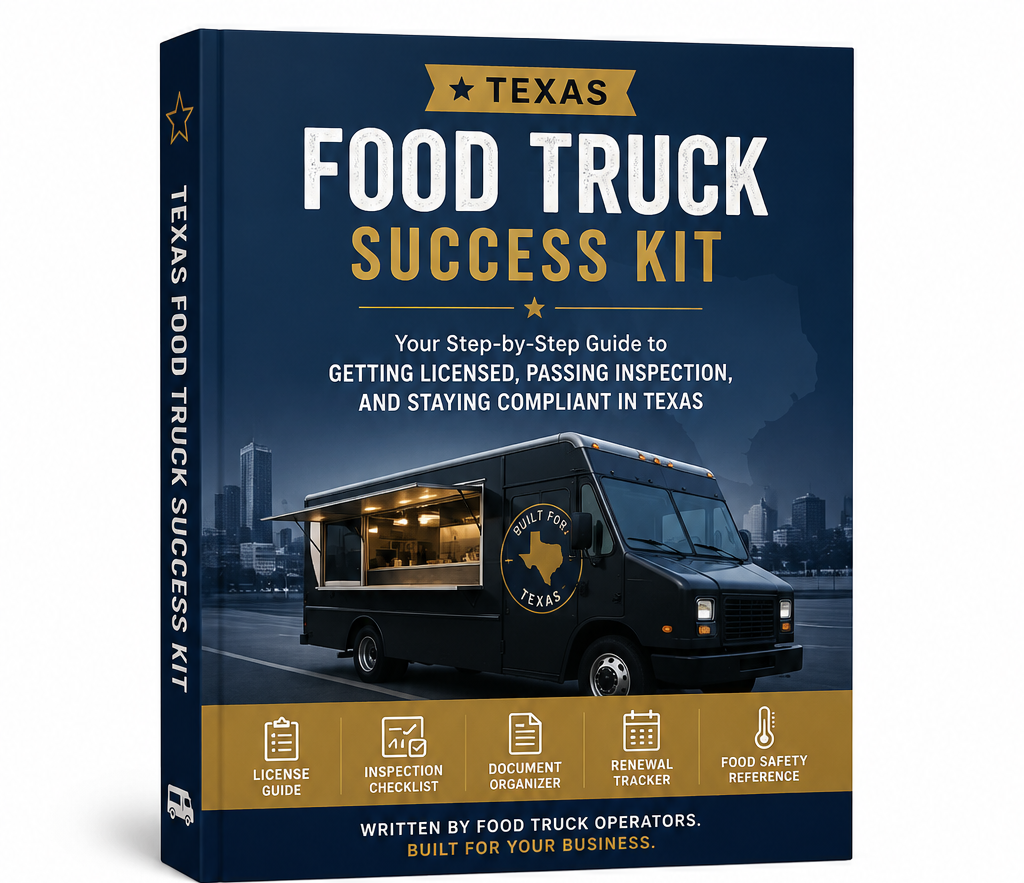
The Texas Food Truck Success Kit walks through everything in this guide — plus checklists, document organization, and inspection prep — in one place. $29, instant download.
GET THE SUCCESS KIT — $29 →Can You Stay Open Through the Transition?
This is the first question every existing operator needs answered. The answer depends on your specific truck, your current local permit status, and your commissary situation.
If you currently hold a local permit, you're a Category 1 applicant — you can continue operating while DSHS processes your application, as long as you carry proof of that local permit and your DSHS application receipt on the vehicle at all times. If you don't have a current local permit anywhere in Texas, you're Category 2 — you cannot legally operate until your pre-licensing inspection is complete.
Don't assume you're fine. Don't assume you're in violation. Confirm it before you spend a dollar on government fees.
Not sure which category you're in, or what's missing from your application?
AUDIT — $99 →What Changed Under HB 2844
Before this law, getting a food truck permit in Texas meant navigating a different process in every city — Houston had its own rules, Dallas had its own, every county health department ran its own system. HB 2844 changed that:
- One statewide DSHS license now covers all of Texas. Apply once, operate statewide.
- No more city-by-city primary health permits for standard mobile food vendor operations — though several major cities still require an additional local business registration (see below).
- Commissary (CPF) requirement clarified. Some fully self-contained trucks may qualify for a CPF exemption, eliminating the need for a commissary kitchen relationship.
- Standardized inspection protocol statewide through DSHS.
- New fee schedule based on MFV type — Type I, II, or III, detailed below.
What Permits You Need in 2026 — Complete Checklist
Every Texas food truck operator needs the following before legally operating under HB 2844:
- 1
Texas Sales and Use Tax Permit
Free. Apply at comptroller.texas.gov before anything else — your Sales Tax Permit number may be required as part of your documentation. Processing is typically same-day to 24 hours.
- 2
Food Manager Certification
Required for operations handling TCS foods. Must be current — an expired certification is an automatic problem at inspection.
- 3
Food Handler Cards — All Employees
Every food-handling employee needs a valid Texas Food Handler Card from an approved provider.
- 4
DSHS Mobile Food Vendor License
The primary statewide license under HB 2844. Your truck is classified as Type I, II, or III based on food preparation complexity. Getting this classification wrong means refiling with additional fees and delay.
- 5
CPF Authorization OR CPF Exemption
You need either a signed authorization letter from a licensed Central Preparation Facility, or an approved CPF exemption. Most Type II and III operations need a CPF unless they qualify for exemption — see our CPF Exemption Guide for details.
- 6
Local Business Registration (Where Required)
Houston, Dallas, San Antonio, and Austin each may still require a local registration in addition to your DSHS statewide license. This varies by city — see city-specific notes below.
Texas Food Truck Permit Cost Breakdown 2026
| Permit / Item | Cost | Paid To |
|---|---|---|
| Texas Sales and Use Tax Permit | Free | Texas Comptroller |
| Food Manager Certification | ~$100–150 | Approved provider |
| Food Handler Cards (per employee) | ~$15–25 each | Approved provider |
| DSHS Application Fee — Type I | $309 | DSHS |
| DSHS Application Fee — Type II | $618 | DSHS |
| DSHS Application Fee — Type III | $876 | DSHS |
| DSHS Pre-Licensing Inspection — Type II | $400 | DSHS |
| DSHS Pre-Licensing Inspection — Type III | $500 | DSHS |
| Failed Inspection Re-Fee — Type II | $400 | DSHS |
| Failed Inspection Re-Fee — Type III | $500 | DSHS |
| Commissary Kitchen (if not exempt) | $200–600/month | Private commissary |
Fee figures verified directly against the official DSHS Mobile Food Vendor fee schedule, July 2026. Type I has no pre-licensing inspection fee under the current published table.
Want your exact total cost based on your specific truck and type?
FREE COST CALCULATOR →Step-by-Step: The Texas Food Truck Permit Process
Sequence matters — submitting out of order is one of the most common reasons applications get delayed:
- 1
Get your Sales Tax Permit
Apply at comptroller.texas.gov early in the process.
- 2
Secure your Food Manager Certification
If expired, renew before applying — DSHS checks this.
- 3
Determine your truck classification
Type I, II, or III, based on your food preparation activities. Getting this wrong means refiling and extra fees.
- 4
Resolve your CPF status
Confirm whether you need a Central Preparation Facility or qualify for exemption — and get the documentation in order before you submit.
- 5
Compile your complete menu
DSHS requires every item listed — not a sample. Incomplete menus cause delays.
- 6
Submit your DSHS application
Online via the DSHS portal, with your documentation, certifications, menu, and CPF status all included.
- 7
Prepare for and pass inspection
Truck must be fully operational and movable — no permanent connections, all equipment properly labeled and installed, certifications physically present.
- 8
Receive your license and open
DSHS issues your MFV license once you pass inspection — valid statewide for one year. Keep it posted visibly in your truck.
Want This Whole Process Laid Out Step by Step?
The Success Kit organizes every stage of this process into one guide you can work through at your own pace — checklists, document tracker, and all.
GET THE SUCCESS KIT — $29 →Common Mistakes That Delay Applications
These issues come up again and again with operators we've worked with:
- Wrong truck classification — Type I, II, or III misidentification means refiling fees and weeks of delay.
- Incomplete menu — any missing item can trigger a return for correction.
- Missing CPF documentation — no authorization letter or an incomplete exemption filing.
- Inspection failure — truck not fully operational, unlabeled equipment, improperly sized water tanks. Costs $400-500 to reschedule.
- Expired or unapproved certifications — outdated Food Manager cert or unapproved Food Handler Cards.
City-Specific Notes for Texas Operators
Under HB 2844, your DSHS license covers all of Texas. But several major markets require an additional local registration alongside the statewide license:
Houston
May require a separate City of Houston mobile food unit registration in addition to your DSHS license. Harris County coordinates with DSHS on inspections.
Dallas
City of Dallas may require additional local registration. Some districts have vending regulations beyond the statewide license.
San Antonio
Metro Health coordinates with DSHS. Local registration may still apply — CPF documentation needs to be complete and correct.
Austin
City of Austin may require an additional local permit. Travis County environmental health still conducts coordinated inspections.
Brownsville / RGV
Cameron County operates under the statewide DSHS framework. One of the fastest-growing food truck markets in Texas. Se habla español.
El Paso / Laredo / McAllen
Border markets operate under the same statewide framework. Local registrations may apply depending on the city.
Do You Still Need a Commissary Kitchen?
Maybe not. Some fully self-contained trucks can qualify for a CPF exemption — potentially saving $200-600/month in commissary fees. Qualification depends on your specific equipment and operation. Read the full breakdown: CPF Exemption Guide →
Your Operation Is On the Line. So Is Ours.
The $99 Audit confirms your status under HB 2844 — including whether you can keep operating through the transition. The $397 Guided Application gets you to inspection day with us beside you. The $1,200 Full-Service handles everything until your license is in hand.
START YOUR PERMIT PROCESS — $99 →
Last Verified: July 14, 2026
Verified Against: Official DSHS Mobile Food Vendor fee schedule, Texas Health and Safety Code Chapter 437B (direct source review)
Updated By: Texas Food Truck Permits Editorial Team